
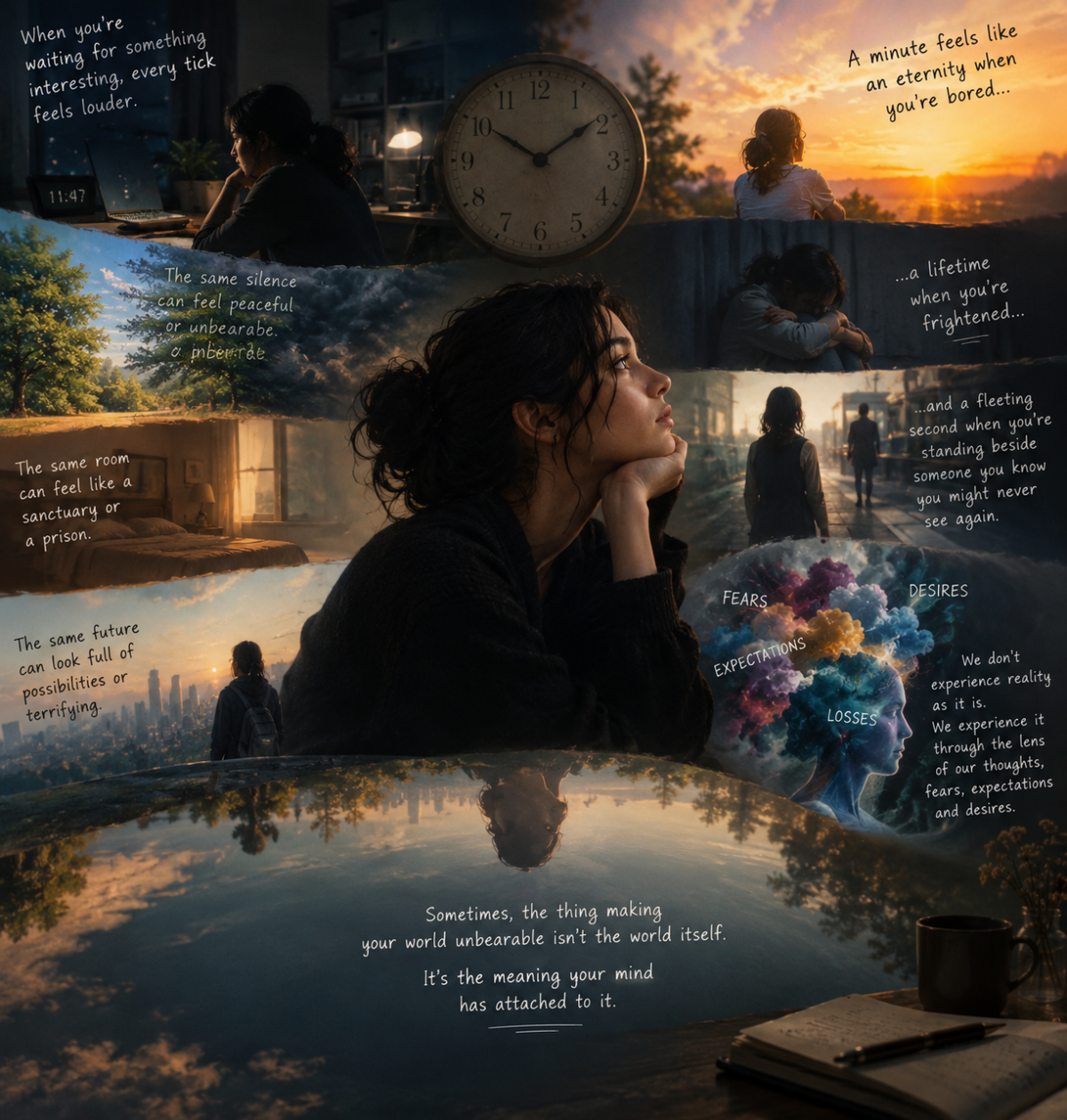
Have you ever noticed that a clock never sounds louder than when you’re waiting for something interesting to happen? Every tick feels like a reminder that time is moving, yet nothing is changing. You check the clock, look away, and check it again, hoping that somehow the hands have moved faster in your absence. But the clock hasn’t changed. Your relationship with time has.
That’s how the human mind works. A single minute can feel like an eternity when you’re bored, a lifetime when you’re frightened, and a fleeting second when you’re standing beside someone you know you might never see again. The seconds remain the same, indifferent to your feelings, yet your experience of them changes completely.
And perhaps that’s one of the strangest things about being human: we don’t experience reality exactly as it is. We experience it through the invisible lens of our thoughts, fears, expectations, and desires.
Think about it. The same silence can feel peaceful when you’re alone by choice and unbearable when you’re waiting for someone to reply. The same room can feel like a sanctuary when you’re happy and a prison when you’re struggling. The same future can look full of possibilities when you have hope and terrifying when you have something to lose.
Nothing around you has to change for everything within you to feel different.
We spend so much of our lives trying to control the world around us. We want people to behave differently, circumstances to become easier, uncertainty to disappear, and life to follow the plans we’ve carefully constructed in our minds. We believe that once everything falls into place, we’ll finally find peace.
But what if peace doesn’t always come from changing your circumstances? What if it sometimes begins with changing the way you interpret them?
This doesn’t mean that suffering is imaginary, that pain is merely a choice, or that every difficult situation can be solved by thinking positively. Some things genuinely hurt. Some losses cannot be reversed. Some circumstances demand action, not acceptance. But even when we cannot control what happens to us, we can learn to question the meaning we attach to it.
A failure does not automatically make you incapable. Someone’s rejection does not determine your worth. An uncertain future does not guarantee a terrible ending. Yet the mind can turn each of these into a verdict, transforming a temporary experience into a permanent identity.
Sometimes, the event hurts you once, but the story you keep telling yourself makes you relive it a thousand times.
We mistake our interpretations for facts. We assume that because something feels unbearable, it must be impossible to endure. Because something feels frightening, it must be dangerous. Because something feels like the end, nothing meaningful can exist beyond it.
But feelings, however powerful, are not always accurate descriptions of reality.
Perhaps growing wiser means learning to create a little distance between what happens and what we believe it means. To recognise that a thought is not always the truth, that a feeling is not always a prediction, and that a difficult moment is not the complete story of our lives.
So, the next time the world feels unbearably heavy, pause for a moment. Look at the situation again. Ask yourself whether you’re suffering only because of what is happening, or also because of what your mind says it means.
You may not be able to change the clock. You may not be able to recover lost time, rewrite the past, or control what tomorrow brings.
But you can learn to see things differently.
And sometimes, the first step towards changing your world is realising that the world you see is not the whole world that exists.
